


Blog & News
How to Become a Freediving Instructor: Complete Guide

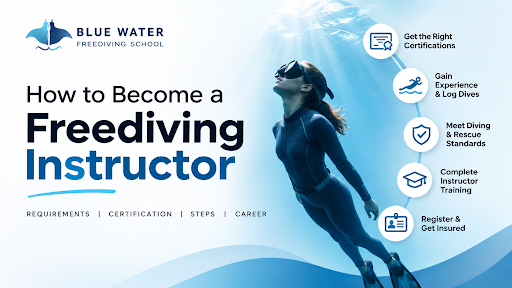
To become a freediving instructor, you will need the right diving qualifications, proper experience, water skills, and an instructor certification. The exact requirements will always depend on the agency and the type of instructor rating you want.
Below, we have mentioned the main steps for you to get an idea:
- You must hold a freediver certification from SSI or any other equivalent qualification, along with the training techniques specialty.
- Gain experience and log your dives. You should have a minimum of 100 logged in-water freediving sessions.
- Meet the required diving and rescue standards.
- Pass an instructor training course.
- Complete professional registration and insurance requirements before teaching. After you are qualified, follow your certification agency’s rules for active teaching status and membership renewal. You will have to check if professional liability insurance is a mandate in the country you are planning to teach.
Blue Water Freediving School offers SSI instructor courses in the London area.
Key Takeaways
- Start with the right qualifications: You’ll need the required freediving certifications before you can train as an instructor.
- Gain hands-on experience: Log your dives, practise your skills and build your confidence in the water.
- Choose your training path: SSI, AIDA and PADI have different requirements, so compare their courses before deciding which one suits you.
- Check the entry requirements: For SSI Freediving Instructor training, you must be at least 18, complete a medical evaluation and meet one of the accepted experience routes.
- Plan your budget: Blue Water Freediving School lists its SSI Freediving Instructor course at £1,500. Flights, transfers and meals for the Poland training are extra.
- Give yourself enough time: The instructor course usually takes 10 days, but your overall timeline depends on your qualifications and experience.
- Learn how to teach safely: Being a good instructor means more than diving well. You also need strong rescue skills, clear communication and patience with students.
- Check everything before booking: Confirm the course dates, fees, entry requirements and any registration or insurance rules before you begin.
What Does a Freediving Instructor Do?
A freediving instructor teaches people to dive underwater while holding their breath. The job includes helping you with theoretical knowledge, pool sessions, open-water training, and safety assessment.
During the theory session, your instructors will conduct an in-depth discussion and will answer and clarify doubts/questions that require further explanation. During the day, you will learn the main freediving disciplines, anatomy, techniques, and safety. Students then take part in pool or confined-water practical sessions, safety training, and assessments. They also begin learning basic open-water skills.
Once you move to the open-water sessions, instructors will again review the theory and skills needed for depth diving. Students can then practise these skills in open water. Blue Water Freediving School says that students could reach depths of up to 20 meters by the end of the weekend, in a relaxed and safe manner.
Teaching requires patience and good judgement. If a student struggles to equalize their ears or feels uncomfortable in the water, the instructor must adjust the session and put safety first.
Freediving Instructor Requirements
The requirements depend on the agency and the rating you want. Below, we have explained the current rules before you book a freedive instructor course.
In general, most professional pathways include requirements for age, diving qualifications, water skills, rescue ability, and medical fitness. Some also require first aid and CPR training.
For the SSI Freediving Instructor rating, the current entry rules include a minimum age of 18, a medical evaluation, and two possible routes into the course.
Candidates need Advanced Freediver and Training Techniques certifications, or recognised equivalents. Additionally, they must also meet one of these conditions:
- Have at least 100 logged in-water freediving sessions.
- Hold the SSI Basic Freediving Instructor rating and have issued at least 25 Basic Freediver certifications.
You can check out more details here: https://www.bluewaterfreediving.com/ssi-freediving-instructor-courses/freediving-instructor/
Certification Level You Need First
The qualifications you need depend on the freediving agency you choose for instructor training.
SSI Freediving Instructor
- Prerequisite certifications: SSI Advanced Freediver and Training Techniques, or recognised equivalents.
- Experience: Candidates must meet one of SSI’s experience routes, as we have discussed in the requirements section above.
- Teaching scope: Blue Water Freediving School says that a certified SSI Freediving Instructor can:
- Teach all entry-level SSI freediving programs.
- Teach the Free Immersion and Training Techniques specialties.
- Act as a certified assistant for the Advanced Freediver program.
- Assist with the confined-water portion of the Performance Freediver course.
AIDA Instructor
- Prerequisite qualification: AIDA 4 Master Freediver, or an accepted crossover evaluation.
- Minimum age: 18 years.
- First aid: First aid certification that includes CPR, completed within the previous two years.
- Instructor training: Candidates must complete the AIDA Instructor Course and meet its required theory, practical, and teaching assessment standards.
AIDA Recreational Certification Levels
- AIDA 3: Advanced Freediver.
- AIDA 4: Master Freediver.
- These are recreational qualifications, not instructor certifications.
- Holding an AIDA 3 or AIDA 4 certificate does not qualify someone as an instructor.
- Candidates holding qualifications from another agency should confirm whether those qualifications are accepted for their chosen instructor pathway before enrolling.
Depth and Performance Requirements
Instructor candidates are supposed to meet the performance standards for their chosen SSI professional rating. These standards can include swimming, static apnea, dynamic distance, depth performance, and rescue skills. The exact requirements depend on the rating.
Do not assume that the same depth or breath-hold target applies to every instructor course. You will have to check the current standards for the specific qualification you plan to earn. Practise freediving with qualified instructors. Never practise breath-holding in water or depth diving alone.
Age, Fitness and Medical Requirements
SSI requires candidates for the Freediving Instructor course to be at least 18 years old and pass a medical evaluation. Check the agency’s current requirements before you enroll. If you come across some possible concerns, follow the agency’s instructions and get medical clearance where required.
Step-by-Step: How to Become a Certified Freediving Instructor
Step 1: Get Your Beginner and Advanced Certifications
If you are absolutely new to freediving, it’s better to start with a recognised beginner course. In this program, you will learn basic techniques, equipment use, and safety assessments, along with theoretical knowledge.
Once you have completed the beginner course, you can then opt for the next qualification. Check the entry requirements for the instructor rating you want before booking more training.
Blue Water Freediving School offers an SSI Beginner Level course and an SSI Advanced Freediver course.
Step 2: Log Dives and Gain Experience
Keep a record of your training sessions. Take note of the skills you practise, the conditions, and the depth reached when relevant. Attend regular pool and open-water sessions. Work on your diving technique, safety checks, communication and rescue skills under qualified supervision.
For the full SSI Freediving Instructor route, one entry option requires at least 100 logged in-water freediving sessions. An alternative route is available to candidates who hold the Basic Freediving Instructor qualification and have issued at least 25 Basic Freediver certifications. Both routes have other qualification requirements.
Step 3: Improve Your Freediving Skills
Instructor candidates are supposed to meet the performance standards for their chosen rating. Depending on the rating, these can include swimming, static apnea, dynamic distance, depth performance, and rescue skills.
Here’s some general information that will help you master your freediving skills, in case you want to know what static and dynamic apnea means. Static apnea means holding your breath while staying still at the surface. Dynamic apnea means swimming underwater on a single breath.
Additionally, Depth training also involves equalization and buoyancy control. Build these skills with qualified instruction and a trained safety instructor. Never practise breath-holding in water or depth diving without someone monitoring you. The exact performance targets depend on the instructor rating. Do not assume that every course requires a 30-meter dive or a particular breath-hold time. Always check the current standards for your chosen qualification.
Step 4: Choose Your Certification Agency
SSI, AIDA and PADI have their own certification systems and ways to become a freediving instructor. Before choosing a course, compare the entry requirements, course fees, assessment rules, and teaching permissions.
Check whether your existing qualifications will be accepted. If you hold a certificate from another agency, ask the training provider whether it counts as an equivalent or whether you need a crossover assessment.
Blue Water offers SSI instructor courses, so SSI is the direct professional route available through the school. If you hold AIDA diving qualifications and want to train through SSI, ask the school which of your certificates will make more sense.
Step 5: Check the Age and Medical Requirements
Check the current age and medical rules before paying for instructor training. For Blue Water’s SSI Freediving Instructor course, the published requirements include a minimum age of 18 and a medical evaluation.
Step 6: Complete the Instructor Course
Instructor training prepares you to teach freediving skills, assess students, and follow the safety rules for your qualification. The training and assessments depend on the agency and instructor rating. Ask the provider for the current course schedule, practical requirements, assessment rules, and full price before booking.
Step 7: Complete Your Professional Requirements
After passing the course, complete any required professional registration and membership steps. Check the insurance requirements that apply to your certification agency and the country where you plan to teach.
Freediving Instructor Certification: AIDA vs SSI vs PADI
Each agency has its own courses and professional requirements. The right route depends on your current qualifications and the programs you want to teach.
| Agency | Instructor route | What to check |
| SSI | Basic Freediving Instructor or full Freediving Instructor | Entry qualifications, experience route, assessments and teaching permissions for the chosen rating. |
| AIDA | AIDA Instructor Course | Current instructor entry requirements, accepted qualifications and assessment rules. |
| PADI | PADI Freediver Instructor Training Course or an approved professional route | Current experience, first aid, medical and certification requirements. |
Check the current requirements with the agencies directly:
SSI Freediving Instructor Course: What to Expect
Blue Water lists two SSI professional options: Basic Freediving Instructor and Freediving Instructor. The two ratings have different teaching permissions.
Basic Freediving Instructor vs Full Freediving Instructor
The SSI Basic Freediving Instructor rating allows instructors to teach and certify students in the Snorkel Diver, Try Freediving, and Basic Freediver programs, after completing the required course requirements.
The full SSI Freediving Instructor rating has a wider teaching scope. Blue Water states that a certified SSI Freediving Instructor can:
- Teach all entry-level SSI freediving programs.
- Teach the Free Immersion and Training Techniques specialties.
- Act as a certified assistant for the Advanced Freediver program.
- Act as a certified assistant for the confined-water portion of the Performance Freediver course.
What the Course Covers
The SSI Freediving Instructor course covers the knowledge and skills needed to teach freediving and manage training sessions. Topics include:
- SSI professional responsibilities
- Freediving equipment selection and maintenance
- Relaxation and breathing techniques
- Programme organisation and administration
- Safety and risk management during training
- Course content and teaching methods for different certification levels
- The business side of diving and career opportunities
Candidates get access to SSI’s online learning materials for Freediving Instructor Training, along with practical training on land and in the water. Blue Water provides basic freediving equipment for the course. Candidates can bring their own gear if they have it. Instructors can help them choose suitable equipment, and the center also sells freediving gear.
Adding a Snorkeling Instructor Rating
Blue Water also lists an SSI Snorkeling Instructor course.
Ask the school which programs this rating allows you to teach and whether you can take it alongside freediving instructor training.
How Long Does It Take to Become a Freediving Instructor?
The training typically lasts 10 days, starting in the UK before continuing at DeepSpot in Poland, where candidates work on depth-related skills. The schedule may be adjusted to suit individual goals and availability. The total time depends on your current qualifications, logged experience, skill level, and course dates.
How Much Does Freediving Instructor Training Cost?
Blue Water Freediving School lists the SSI Freediving Instructor course at £1,500.
The price includes:
- Pool sessions and lectures in the UK
- One night’s accommodation in Poland
- Three dive entries at DeepSpot
- Additional lectures at DeepSpot, including an equalization workshop
The price does not include:
- Return flights to Poland.
- Airport transfers
- Meals
You can also ask about equipment hire through Blue Water’s equipment hire service before buying your own gear.
Freediving Instructor Salary and Jobs
Freediving instructors work in different ways. Some teach part-time or seasonally, while others work at dive schools or in destinations where freediving is popular. Their income depends on location, experience, demand, and how often you teach.
Freediving Instructor vs Coach: Which Path Fits You?
An instructor teaches recognised courses and checks whether students meet the agency’s certification standards. A coach will help divers improve their technique, training, or competition performance. Some professionals can do both. Instructors must follow their agency’s course rules and teaching permissions. Coaches need the right skills and experience for the divers they train.
You can learn more about Blue Water’s staff on its team page.
Skills That Make a Good Freediving Instructor
Strong diving skills are only part of teaching. An instructor also needs to explain techniques clearly, spot problems, and know when to stop a session.
Good instructors:
- Keep their rescue skills current and follow safety rules.
- Give students clear feedback they can use.
- Support nervous students without pushing them beyond their limits.
- Explain the plan and safety steps before each session.
- Know which programs their rating allows them to teach.
Common Mistakes When Training to Become an Instructor
Moving through certifications too quickly isn’t a great idea. One must gain the required experience before enrolling, and ask your instructor trainer which areas need more practise.
Do not focus only on depth or breath-hold times. Practise rescue skills and safety procedures as well. Check the full cost before choosing a provider. Include registration, insurance, equipment and any extra training fees. Finally, confirm which courses you can teach once you qualify.
Bottom Line
Blue Water Freediving School’s pool location is Whitings Hill School in Barnet, London. Open-water training takes place at Wraysbury Dive Center, while instructor training may also include deep-pool sessions at DeepSpot in Poland, depending on the course schedule.
Check your current qualifications and logged experience before choosing a course. Blue Water Freediving School offers SSI instructor training for candidates who meet the required standards.
Contact Blue Water about the SSI Freediving Instructor course to ask about entry requirements, course dates, and fees.
FAQs About Becoming a Freediving Instructor
How do I become a freediving instructor?
Complete the required courses, gain practical experience, meet your agency’s performance and rescue standards, and pass an approved instructor course. Then complete the professional registration and insurance steps that apply to you before teaching.
What qualifications do you need to be a freediving instructor?
The requirements depend on the agency and instructor rating. For the full SSI Freediving Instructor route, candidates need Advanced Freediver and Training Techniques qualifications or recognised equivalents, plus either 100 logged in-water freediving sessions or the alternative Basic Freediving Instructor route with at least 25 Basic Freediver certifications issued.
How long does it take to become a freediving instructor?
The time depends on your current qualifications, experience, training schedule, and assessment results.
How much does a freediving instructor make?
Earnings depend on where you work, how often you teach, and whether you work for a school or independently. Use a reliable, current source before quoting an average salary.
Do I need to be a scuba instructor first?
Not for every freediving instructor pathway. SSI and PADI have their own freediving instructor requirements. Check the rules for the rating you want.
What is the difference between a freediving instructor and a coach?
An instructor teaches approved courses and assesses students for certification. A coach helps divers improve their technique, training, and performance. Some professionals do both.
Which agency is best: AIDA or SSI?
The right choice depends on your current qualifications, the entry requirements, teaching permissions, and fees. Blue Water offers SSI instructor courses, so SSI is the direct option to discuss with the school.
Can I become a freediving instructor in the UK?
Blue Water advertises SSI instructor training and lists pool sessions at Whitings Hill School and open-water training at Wraysbury. Contact the school to confirm the current schedule, location, and entry requirements.